
Dride is an driving school company that specializes in teaching driving an help to get certificate to their learning customers..

- 07966677777
- 75a Crawley Road, Luton, Bedfordshire, LU1 1HX
- info@kwikpass.org

Dride is an driving school company that specializes in teaching driving an help to get certificate to their learning customers..
A: No, unlike other driving organisations and schools we run Part 2 and Part 3 all in-car. This is the best way we feel you will become the best possible driving instructor you can, we believe in the philosophy of teaching by doing. You wouldn’t teach a student how to drive in a classroom and would instead want them to gain as much practical understanding as possible, so why should our Part 3 Instructor Training be any different!
Learning with an instructor in-car means for a far more focused and organised learning environment, where your instructor’s provision of attention is directed entirely towards developing your personal skillset as opposed to offering general guidance to a class of up to 30 people.
A: Please call us on 079 666 777 77 to discuss your circumstances and potential payment plans available.
A: If you, or your trainer, feel you would benefit from some further tuition that can be arranged either directly with your trainer or by contacting the Training Department at KWIK PASS.
A: At KWIK PASS we recommend a driving lesson price of £25.00 (or £27.00 for automatic) per hour, therefore this is what you will earn directly. We do not charge you for the pupil, nor deduct any of your hourly earners as a transaction fee. You collect the funds and they go straight into your bank account.
A: Ultimately it is up to you, as you work the hours you and your pupils agreed upon. Upon joining KWIK PASS we will set your profile radius, open your booking diary and start marketing you as a KWIK PASS Instructor. Once we pass on the pupil referrals (at no charge), you will arrange a convenient time with your pupils. If you need to fit your lessons around your family, football team or even improving your golf handicap – you can!
A: The ADI driving instructor test prices are separate to the cost of training and you pay the DVSA directly. The test prices are as follows:
ADI Part One – Theory Test: £81
ADI Part Two – Driving Ability: £111
ADI Part Three – Instructional Ability: £111
A: Entry to the DVSA Register is £300
A.You’ll need a MyDrive TomTom account for this to work, so you can either use the account you made when setting up your TomTom or you can create a new one. You can create an account by visiting the TomTom’s website.
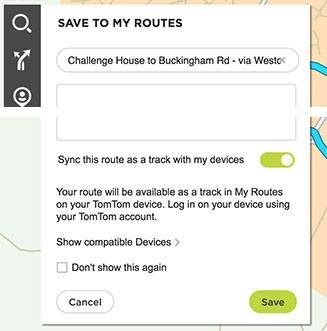
You will need to go to the TomTom website and log in with your TomTom account details. Search for wherever you would like the route to start from. For this article, we are going to use Challenge House in Bletchley. You can do this by either scrolling around the map or searching for a particular place in the search bar. Once you have chosen your location, left click on the map to set it as the starting position. When you click, the location will be highlighted with a blue circle with a white arrow in the centre of it and a box will have appeared on the left hand side titled “Plan Route” – if it wasn’t there already.
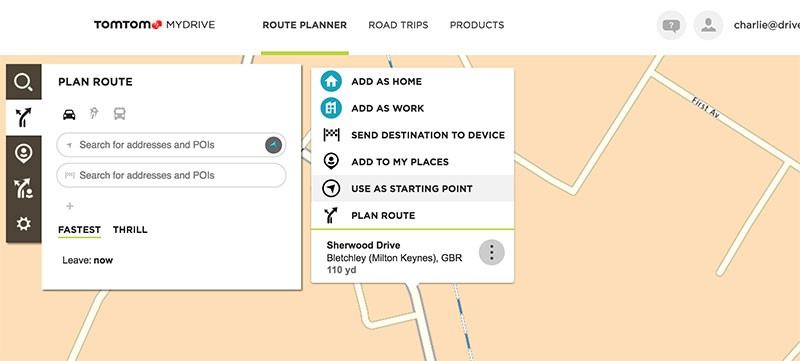
To begin planning the route, click on a position further along in your route. In this example, we want to travel to the end of Sherwood Drive, turn right and follow Whalley Drive towards Whaddon Way. By clicking on a point along this route, a new box will appear with an option to plan your route. Click “Plan Route”.
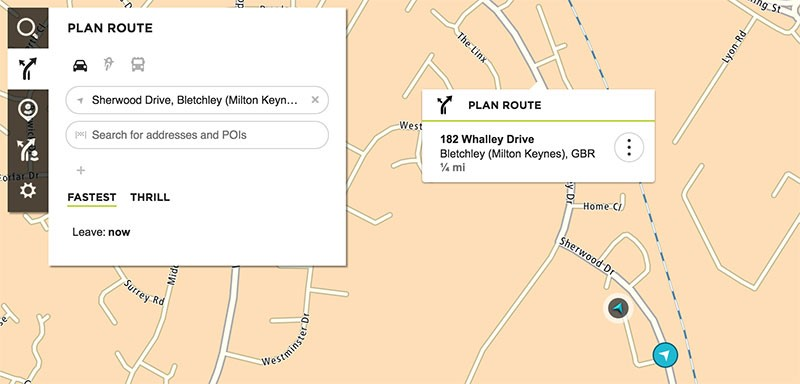
will now highlight blue from the starting point to your current position.
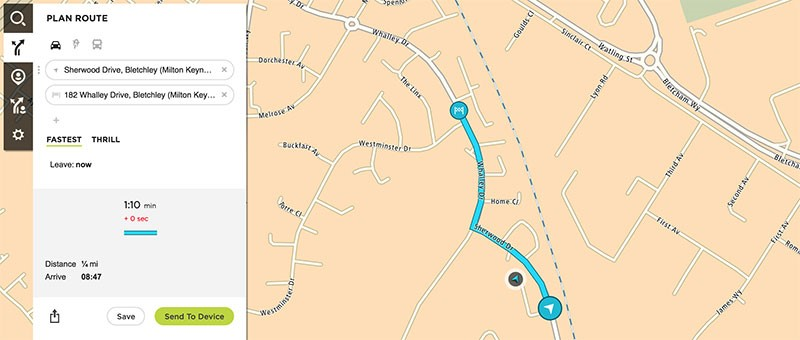
on the left hand side, you will need to change the route type to “Thrill” and disable the “Round Trip” option. This will stop the planner from creating a loop from the start to the end point. To continue planning your route, just drag the finish line icon around the map. Sometimes the map will try to be intelligent and jump your line to another road. When this happens, you can right click on your intended road and click “Add Stop”. Don’t over use the stops though as there is a limit per route, so only use it when you need to force the route in a specific direction.
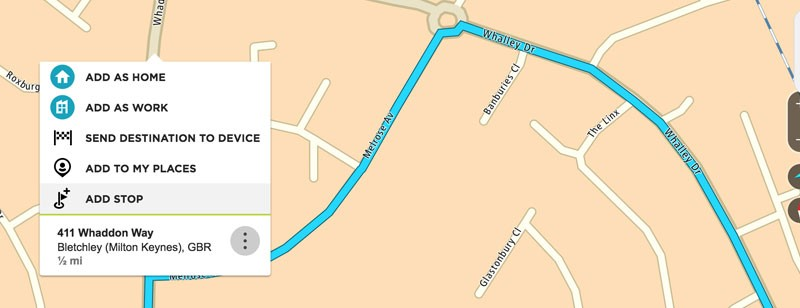
Alternatively you can just set an ending location using the box on the left. This is probably better for longer routes – you can just add stops to the different places you want to travel via.
Please see list of insurance brokers/insurance companies providing driving instructor insurance, which offer insurance specifically for driving schools and driving instructors. We advise you get as many quotations as possible to get the best deal out there which will be affordable and meets your needs. Some ares you might consider when obtaining quotations are:
| Insurance Provider / Broker | Contact Number | Website Link |
| Adrian Flux | 0800 369 8590 | Website |
| Academy Insurance | 0800 458 0791 | Website |
| Arthur J Gallagher | 0845 7697 323 | Website |
| Barry Grainger (BG) | 01892 501 501 | Website |
| C&A Mackie | 0141 423 8555 | Website |
| CIC | 01628 531 411 | Website |
| Connect | 01782 200 711 | Website |
| Coversure | 0800 308 1000 | Website |
| DCL | 0208 773 5261 | Website |
| DIA | 0800 458 0823 | Website |
| Hamilton Robertson Insurance Brokers ltd | 0141 776 7600 | Website |
| Instructor Cover Plus / Watkin Davies | 029 2062 9413 | Website |
| Insurance4Instructors | 01603 301770 | Website |
| Lloyd Latchford | 01844 275 555 / 0800 707 6807 | Website |
| Mastercover | 0208 236 3600 / 0800 731 3378 | Website |
| MCB Insurance | 01208 833 050 | |
| My Money Comparison | Website | |
| Park Insurance | 01454 411187 | Website |
| Policywave | 0333 332 7750 | Website |
| Premierline | 0333 320 6009 | Website |
| Quote Me Today Insurance | 01227 285 540 | Website |
| Quote Searcher | Website | |
| Quote Zone | Website | |
| Safeway Insurance Services | 0208 004 20 20 | Website |
| Simply Insurance | 01708 632000 | Website |
| Waveney / Towergate Insurance | 01603 753 888 | Website |
A.Top ten tips of what to do
GDPR stands for the General Data Protection Regulation.
As of the 25th May 2018, all businesses are expected to comply with the new GDPR law. As a business, self-employed driving instructor, driving instructor franchisee, this will affect you. You should demonstrate a duty of care to your customers/clients/learners in how you handle and store their data and personal information.
For very large companies this is quite a serious matter. For some smaller businesses it is still serious but the likelihood of being hacked online and having your data stolen for all of your clients is considerably lower. However, there are many instances of failing to comply with the new GPDR law. We will cover those relevant to driving instructors below.
Everything such as your learners’ personal information should be kept confidential and stored in a safe place. If you take a learner/client’s information by pen and paper, this should not be kept in your car overnight and should be stored in a safe place at your home or office, in a locked filing cabinet. If you store customer/client/learner information by computer, tablet or mobile phone, then your device should have a password on it. Any applications (apps) you use to store information should also be password protected and you shouldn’t leave your device, whether tablet, phone or computer, unattended in your car at night.
Confidential information to consider: client/learner’s full name, address, phone numbers, driving licence/provisional driving licence, email address, payment methods, bank details should be stored.
Other confidential information to consider is what you post on social media about your clients/learners. Whether it be a screen shot of a testimonial, the client/learner cancelling on you at short notice, pass pictures etc. These all count as information about the client/learner and should not be posted to the public domain without their consent. As a company we had one instance in which the learner was taking their driving lessons in Bedford and passed first time with one of our instructors. The pass picture was posted on Facebook, however the mother complained and wanted the pass picture taken down. Just be mindful and protect yourself as sometimes people change their minds and with nothing in writing it’s hard to prove a verbal agreement.
Discussing or sharing information verbally, by email or by text message. Be mindful when you are sharing a learner/client’s information that they are happy for you to pass on their name/number/email etc. This shouldn’t cause major issues for driving instructors, but you can see why some big companies such as Facebook have come under scrutiny for selling information and data.
The main immediate concern for driving instructors would probably be the following: storing learner/client information safely and securely, reporting any incidents to the police in the event this information was stolen – most likely if on a mobile phone or tablet.
Having a backup of the information is paramount so you can report to anyone that could have been affected that their information is potential accessible. Be careful of what you share on social media regarding learners/clients. If in doubt, get their consent before posting – even by text message is enough to cover yourself.
Here are some more examples:
If your learner/client’s data/information is lost then you should contact everyone concerned and let them know. Obviously do what you can such as changing passwords to stop any immediate access if possible.
If your learner/client’s data/information is stolen then you should report it to the police and obtain a reference number and then follow the guidelines for lost/stolen below.
Depending on the information lost/stolen, certain learners/clients may try to sue you if they are caused harm and distress. If your phone or tablet is stolen and no learners/clients are affected, then it would be very hard for them to seek compensation.
Here are a few examples:
Visit the following links for more information on the consequences:
A data breach is any situation where an outside entity gains access to user/learner/client data without the permission of the individual. Data breaches often involve the malicious use of data against users/learners/clients. If a data breach should occur, the GDPR specifies that companies must provide adequate notification. The affected company has 72 hours to notify the appropriate data protection agency and must inform affected individuals “without undue delay.”
This is unlikely to affect driving instructors immediately, but it is still possible. You should be mindful that fines for non-compliance can be as high as 4 percent of revenue. Regulators are likely to look more kindly on companies who are trying to be compliant.
The above article is not legal advice. All of the content above is an interpretation of how the GDPR law affects driving schools, driving instructors and franchisees. If you are unsure about the GDPR law then should consult a solicitor for guidance.
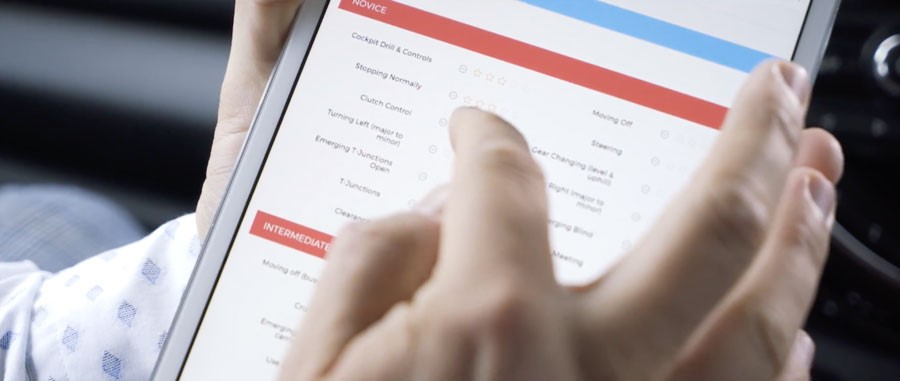
A.With the DVSA moving over to marking tests by iPad/tablet, it’s inevitable the examiners marking the standards check and part 3 tests will be looking at the use of technology in lessons more favourably too.
Every year, major companies are also looking and progressing to more paperless ways of running their business to reduce running costs and help the environment. So why not start making the change yourself as a driving instructor?
Get ahead of the times so you’re ready, rather than being a step behind and the last person on the wagon, so to speak.
Here are a few examples of technology and practical tools that can be used in lessons:
Things to remember
The technology mentioned above can only be used when the car is stationary, the engine is switched off, you are parked up in a safe, legal, convenient place and the key is not in the ignition barrel.
Be sure to address the fault or problem while the car is moving, so the pupil can recall the incident better when the car has stopped.
A picture is worth a thousand words. These are great ways to coax answers out of your pupils, helping them think and come up with solutions to problems themselves. If you can do this, you are transferring ownership to them more and getting them to discover the answers – which they’re more likely to remember.
You can apply for a trainee driving instructor licence after you pass the ADI part 2 test.
This allows you to get 6 months experience of providing on-road instruction before your ADI part 3 test.
You can register as an ADI when you’ve passed all 3 qualifying tests. You must register within one year of passing the ADI part 3 test.
When you have passed what are you then allowed to be called
call yourself a ‘Driver and Vehicle Standards Agency Approved Driving Instructor (Car)’
charge money (or monies worth) for giving driving instruction
apply for permission to use DVSA logos to show you’re approved
register to have your details shown on the GOV.UK service to find driving schools, lessons and instructors
Your registration will last for 4 years.
You’ll be training drivers to meet the national standard for driving cars and light vans. It sets out the skills, knowledge and understanding they need to be a safe and responsible car or van driver.
You can use the learning to drive syllabus as a way of teaching people the skills, knowledge and understanding.
You must take and pass at least one ADI standards check during each 4-year period you’re registered as an ADI.
The purpose of the check is to make sure you have kept up your standard of instruction. The ADI Registrar will contact you to tell you to book your standards check via the online booking platform. It doesn’t cost anything.
You’ll need your:
You can be removed from the ADI register if you:
refuse to take the standards check
Your pupils can either book their tests themselves, or you can book them.
You can use services to:
book and manage driving tests for your pupils
book and manage theory tests for your pupils
You can sit in and observe your pupils’ driving tests but you cannot take any part in the test and you must follow certain rules.
You will need to pay franchise fee if you work with KWIK PASS. You need to set up as a sole trader to do this. You’ll need to provide your own dual-control car that meets the rules to be used for driving tests and pay for repairs and insurance.
Pass Plus is a practical training course that takes at least 6 hours and is for drivers to improve their skills and drive more safely.
It can be taken at any time although it should be most useful to new drivers in the year after passing their test.
You must register to teach Pass Plus. You do not need to take any extra training or tests to teach it.
DVSA encourages you to join ADI associations and organisations so your interests are properly represented in talks. Each organisation has its own terms and conditions.
You can sign up to the voluntary code of practice agreed by DVSA and the driving instruction industry.
DVSA encourages you to take continuing professional development (CPD). This is voluntary development to keep your skills up to date.
You decide how you do it and pay any costs involved. Take the DVSA special test for instructors. You can take the voluntary DVSA special test to test your driving skills to the highest standard.
At the end of the test, you’ll get a grade gold, silver, bronze or fail. You can use it when you advertise your services.
You’re responsible for your ADI registration, including renewing it and keeping your registration up to date. You must write to the ADI Registrar within 7 days if you get a caution or conviction.
This includes:
Read about how to manage your registration.
You must update your ADI registration within 7 days if your name or permanent home or business address change.
You’re responsible for renewing your ADI registration every 4 years.
You must get a criminal record disclosure check before you renew your registration. You must still be a ‘fit and proper’ person. Renew your ADI registration
You can re-register as an ADI if your registration ran out in the last 12 months. You must get a criminal record disclosure check first.
You’ll get a letter from the ADI Registrar if they intend to remove you from the ADI register. You’ll have the opportunity to respond and give them any supporting evidence.
The ADI Registrar will look at all the facts of the case and will make a final decision. You’ll get a letter to tell you about the decision.
Usually, your name will not be removed from the register until 28 days after the date of the letter. This lets you appeal against the decision.
Your name will be removed from the register if you do not appeal.
The ADI Registrar can also use the immediate removal process where you’ll be told that your name will be removed from the register within 14 days, unless:
you appeal to the General Regulatory Chamber within 10 days of the date of the removal letter.
The ADI Registrar can suspend your ADI registration immediately if they think you pose a significant threat to public safety.
You can appeal to the General Regulatory Chamber if you disagree with a decision the ADI Registrar makes about your registration.
You should sign up to get email alerts from DVSA on issues affecting ADIs, including things like:
DVSA runs the Despatch blog for driver and rider trainers, which gives official advice and information for you. You could miss out on important information if you do not sign up for email alerts and the Despatch blog.
You can also follow DVSA on Facebook and Twitter for updates.
ADI test and registration fees are set by DVSA – fees for driving instructor training vary and are set by training organisations. Driving test costs for your pupils are also set by DVSA.
More information and the full legal requirements about driving instruction are in these acts and regulations
The Road Traffic Act 1988 (as amended)
The Motor Cars (Driving Instruction) Regulations 2005 (as amended)
Driving Instruction (Suspension and Exemption Powers) Act 2009
The Driving Instruction (Compensation Scheme) Regulations 2012

